Bar Pipa
We pay for a post of 10$

Oil Plunges 4%: Peace With Iran Sends Prices Tumbling, But It’s Too Early to Celebrate
Oil Plunges 4%: Peace With Iran Sends Prices Tumbling, But It’s Too Early to Celebrate
Monday: A Day of Major Relief

On Monday morning, when Asian traders returned to their desks after the weekend, they saw what many had been waiting for since the start of the year. Oil prices collapsed. Not a minor correction, not a half-percent decline—but a genuine plunge.

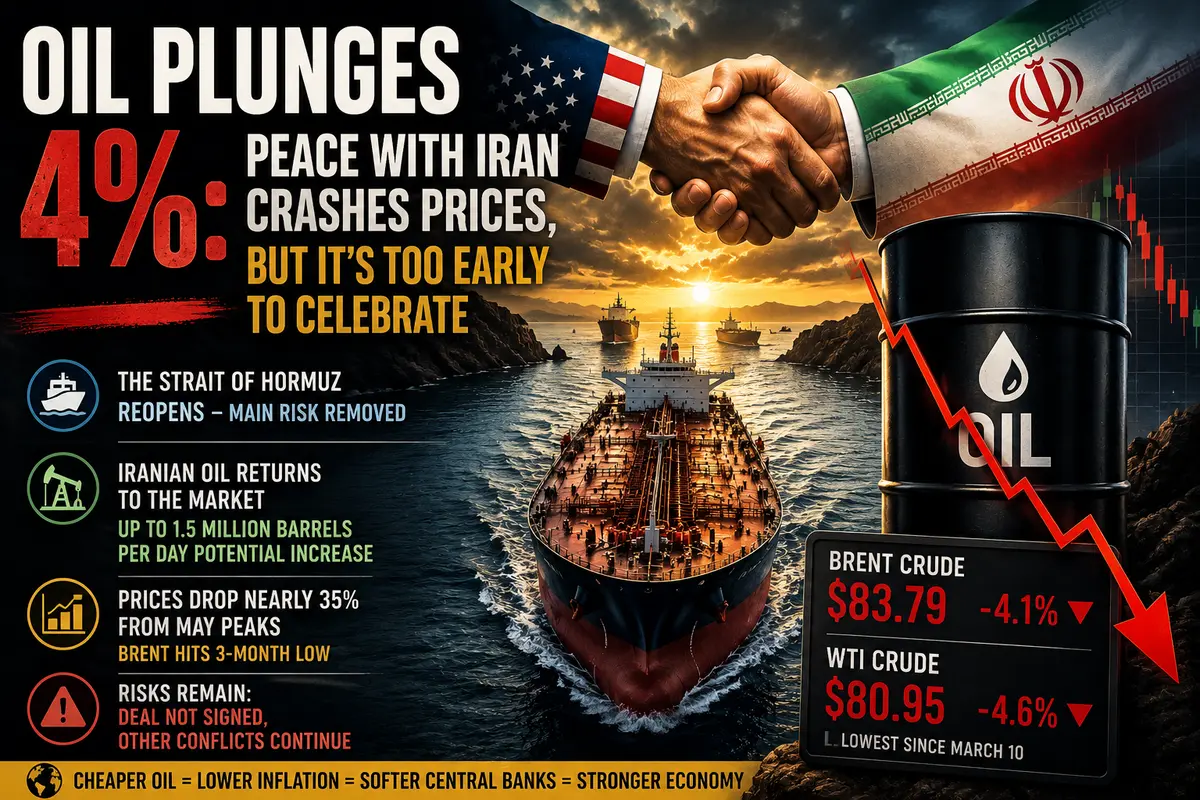
Brent crude futures fell 4.1% to $83.79 per barrel, while WTI dropped 4.6% to $80.95. Both benchmark grades hit their lowest levels since March 10. These are the lowest oil prices seen in three months.

The reason? Peace. Real, long-awaited, almost unbelievable peace between the United States and Iran.

On Sunday, President Donald Trump and Iranian officials issued a joint statement announcing a framework agreement to end hostilities and restore shipping through the Strait of Hormuz.

This is not merely another ceasefire—several of which have been reached and broken over recent months. It is a framework agreement designed as the foundation for a long-term peace settlement. The deal includes a ceasefire, the lifting of the U.S. blockade on Iran, restrictions on nuclear activities, and—most importantly for the oil market—the normalization of Iranian oil exports and the unrestricted passage of tankers through the Strait of Hormuz.

Trump, characteristically enthusiastic, posted on social media:

“Ships of peace, start your engines. Let the oil flow!”

And flow it did. Or rather, the price of oil fell sharply.

But let's take a closer look at what is really driving this decline, how sustainable it may be, and what comes next.

The Strait of Hormuz Reopens: The Biggest Risk Has Been Removed

For oil markets, the Strait of Hormuz is far more than a narrow waterway between Oman and Iran. It is the Achilles’ heel of the global economy.

Roughly one-fifth of the world’s oil and fuel consumption passes through the strait—between 17 and 20 million barrels every...

Continue reading...
0
0

Gold Surges 2%: Peace with Iran Turns Everything Upside Down

Gold Surges 2%: Peace with Iran Turns Everything Upside Down
Monday: The Day Everyone Was Waiting For

When Asian markets opened on Monday morning after the weekend, traders saw something that made them rub their eyes in disbelief. Gold, which had been hovering near 11-week lows around $4,000 just a week ago, suddenly surged higher.

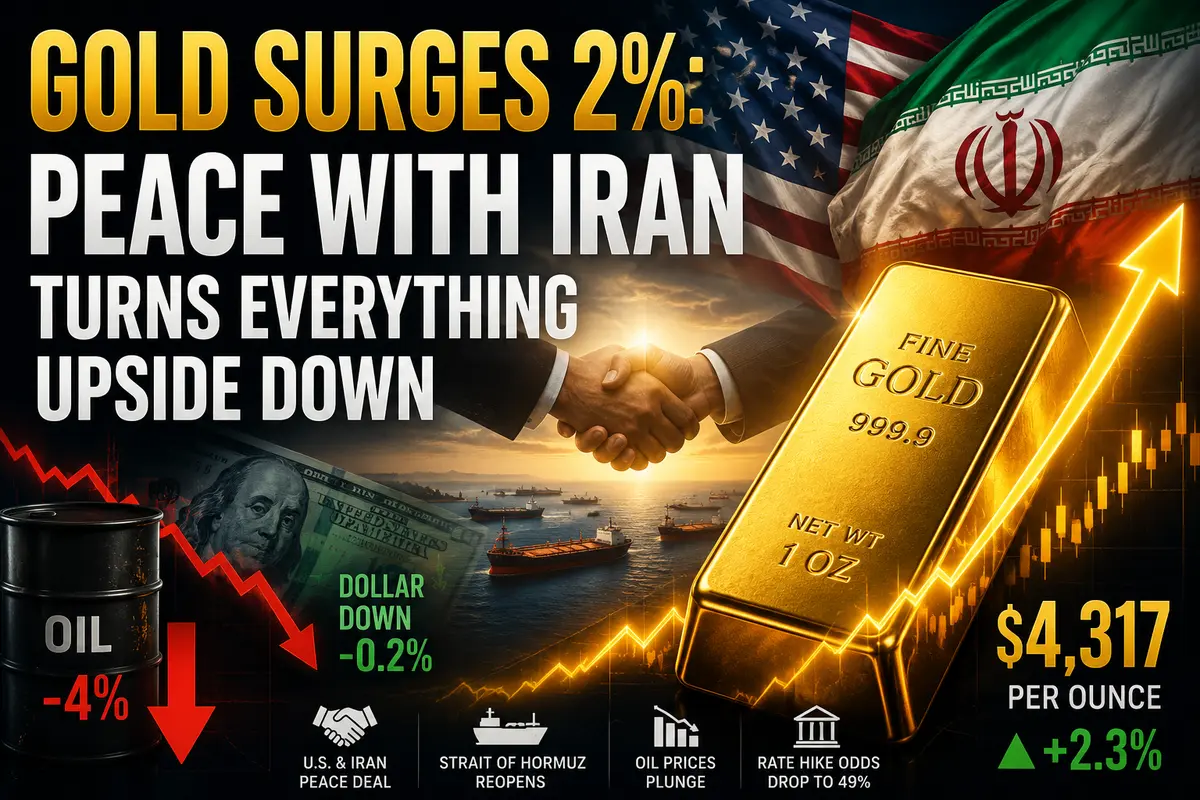
Within a few hours, gold jumped 2.3%. Spot prices climbed to $4,317 per ounce, while futures rose to $4,338.

What happened? Isn't gold supposed to fall on news of peace?

After all, gold is traditionally considered a safe-haven asset. When peace breaks out and risks decline, investors usually sell gold and move into riskier assets. That's how it has worked during wars and crises for the past 50 years.

But this conflict was different.

Throughout months of fighting in the Middle East, gold behaved paradoxically. It didn't rise when missiles were flying—it fell. Markets weren't focused on the war itself, but on its consequences for inflation and interest rates.

Expensive oil = higher inflation = higher Federal Reserve rates = weaker gold.

A simple, albeit twisted, logic.

Now that the United States and Iran have reportedly reached a temporary peace agreement, that logic has reversed:

Peace = cheaper oil = lower inflation = lower interest rates = stronger gold.

Gold is finally pricing in what it failed to reflect during months of conflict.

A Framework Peace Agreement Changes the Narrative

On Sunday, U.S. and Iranian officials reportedly announced that they had reached a framework peace agreement.

Not a complete settlement. Not a permanent solution. Not a comprehensive accord.

But enough to halt military operations.

The agreement reportedly includes:

A ceasefire

The lifting of the U.S. blockade on Iran

Most importantly, the reopening of the Strait of Hormuz to commercial shipping

Pakistani Prime Minister Shehbaz Sharif, apparently involved as a mediator or close observer, stated that...

Continue reading...
0
0
Lin Brings

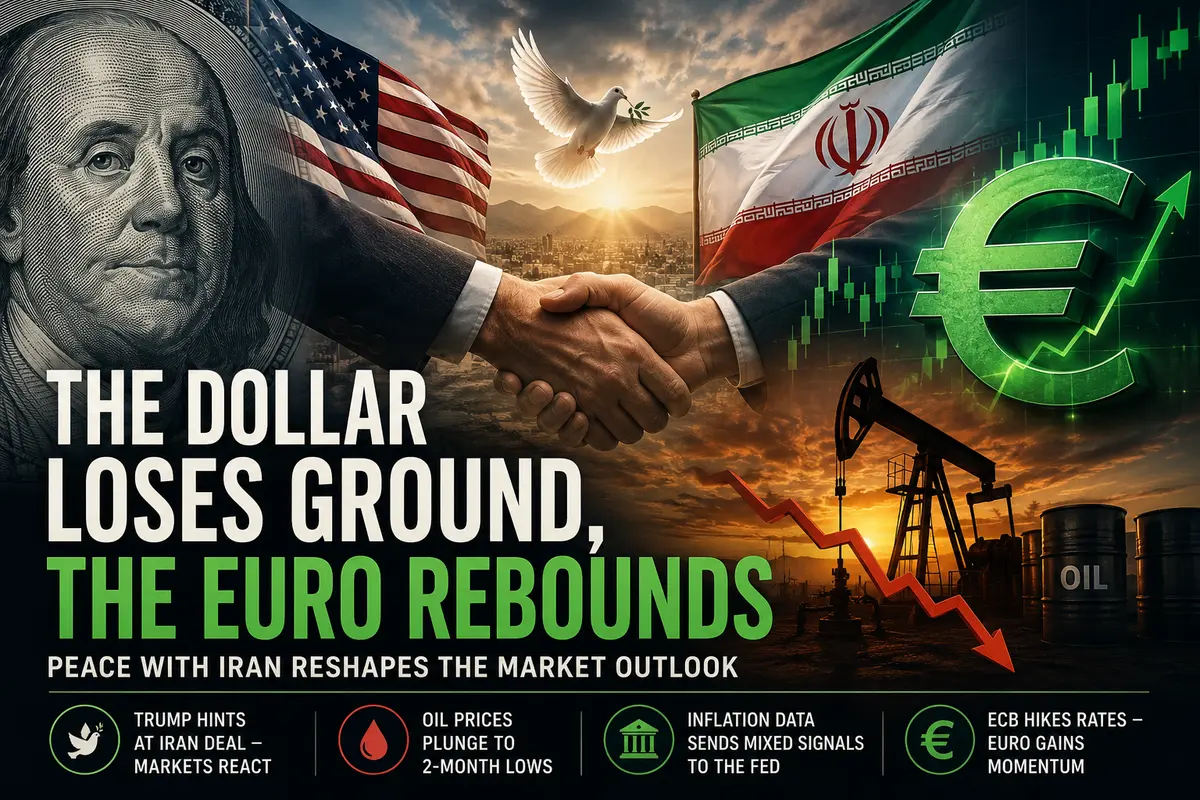
The Dollar Loses Ground, the Euro Rebounds — Peace with Iran Reshapes the Market Outlook

The Dollar Loses Ground, the Euro Rebounds — Peace with Iran Reshapes the Market Outlook
Friday: A Day of Diplomatic Optimism

Throughout Thursday and Friday, currency markets remained in a state of nervous anticipation. Not the sticky fear that accompanies missile strikes, but rather a cautious hope — what if? What if the seemingly endless Middle Eastern crisis, which has flared up intermittently for months, is finally approaching its conclusion? What if Trump, known for making bold statements, is telling the truth this time? What if a peace agreement with Iran is actually signed this weekend?

Investors decided that the mere possibility was enough to act. The U.S. dollar, which had strengthened in recent weeks amid geopolitical uncertainty and expectations of further Federal Reserve tightening, gave up some of its gains on Friday. The U.S. Dollar Index (DXY) fell 0.1% during London trading, stabilizing after touching its lowest level of the week. For the week as a whole, the index is down 0.3%. Not a dramatic move, but a symbolic one: the trend has shifted.

The euro, by contrast, regained momentum. EUR/USD hovered near its highest levels of the week and appeared set to post its strongest weekly performance in more than a month. The rally was supported not only by easing geopolitical tensions but also by the European Central Bank’s first interest-rate hike in nearly three years. While the Federal Reserve remains on pause, the ECB has finally taken a step it had been discussing for months.

So what happened? Three key factors are driving the story: Donald Trump’s peace overtures toward Iran, the sharp decline in oil prices triggered by those remarks, and U.S. inflation data that turned out to be less alarming than many had feared.

Trump Hints at an Iran Deal — and Markets Believe Him

The primary catalyst came on Thursday, when Donald Trump suggested that a peace agreement between...

Continue reading...
0
0

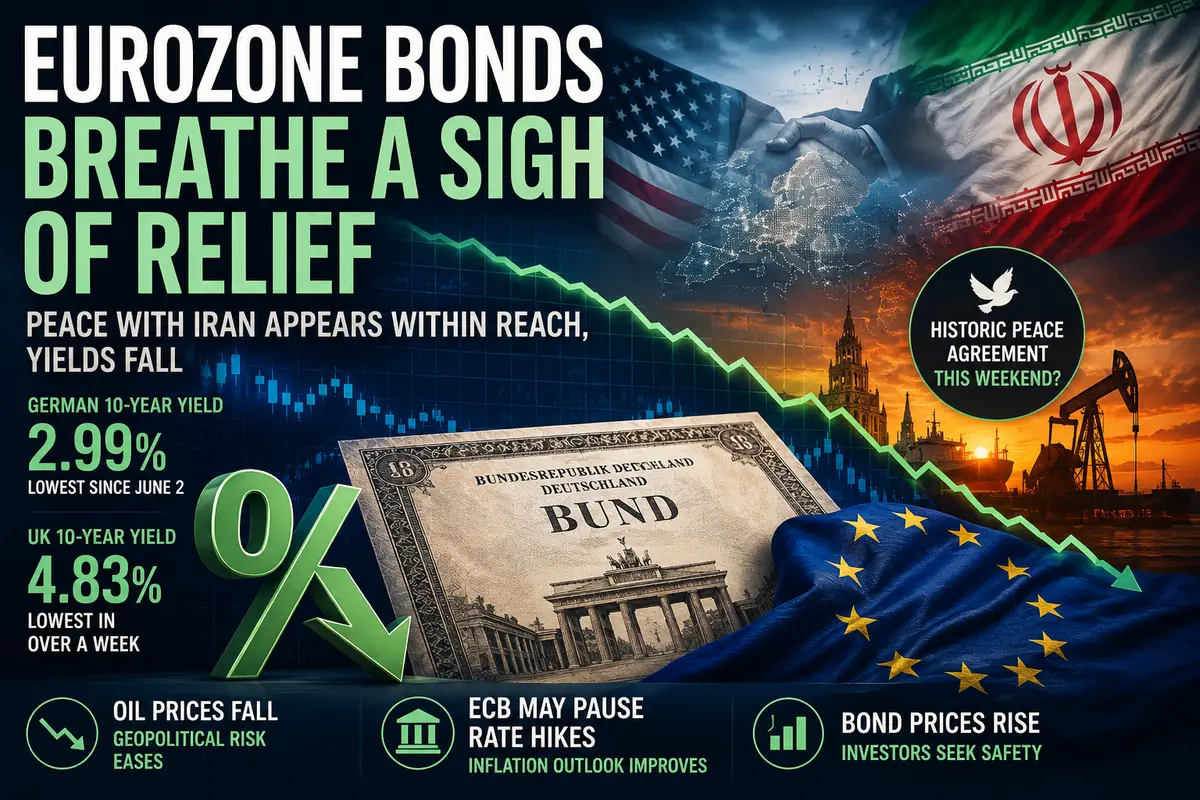
Eurozone Bonds Breathe a Sigh of Relief: Peace with Iran Appears Within Reach, Yields Fall

Eurozone Bonds Breathe a Sigh of Relief: Peace with Iran Appears Within Reach, Yields Fall
Friday: A Day of Hope for Diplomacy

On Friday morning, European markets woke up with the feeling that the heavy burden weighing on them for months had suddenly become a little lighter. It had not disappeared or melted away—it simply stopped suffocating them. Eurozone government bonds rallied, which means their yields declined.

That may sound counterintuitive to those accustomed to thinking that “up” is good and “down” is bad. In the bond market, however, the opposite is true: when bond prices rise, yields fall. And on Friday, the yield on benchmark 10-year German Bunds dropped below 3% for the first time since early June.

Three percent is a psychological threshold. Above it lies a zone of pain, where borrowers—governments, corporations, and mortgage holders—feel the rising cost of money. Below it lies a zone of relief, even if that relief proves temporary.

What happened? Geopolitics.

Donald Trump, who rarely delights markets with predictability, delivered a statement that bond traders would almost be willing to build him a monument for. He said that a historic peace agreement between the United States and Iran could be signed in Europe as early as this weekend.

If true—and Trump is known for presenting wishes as realities—the conflict in the Middle East, which has flared on and off since spring, could finally come to an end. Iran would stop threatening to close the Strait of Hormuz. Israel would halt strikes on the outskirts of Beirut. Oil prices, already at two-month lows, could fall even further. Eurozone inflation, fueled by expensive energy, would begin to slow. And the European Central Bank (ECB), which has been forced to raise interest rates to combat inflation, could at least afford to pause.

All of this is music to the ears of bondholders.

Bonds thrive on low inflation and low interest...

Continue reading...
0
0
NorthRay

I Almost Lost My Crypto by Sending It on the Wrong Network. Here’s What I Learned About Crypto Networks (and How You Can Avoid My Mistake)

I Almost Lost My Crypto by Sending It on the Wrong Network. Here’s What I Learned About Crypto Networks (and How You Can Avoid My Mistake)

Hi, this is NorthRay.

Remember when I told you I bought Bitcoin on Binance?

I was happy. Proud of myself. I felt like a real crypto investor.

Then I thought, “Why not transfer some crypto to another wallet? Just for experience. Let’s see how it works.”

I opened my wallet, copied the address, and clicked Send.

Binance asked me to choose a network. I saw a list: BEP20, ERC20, TRC20, and a bunch of other confusing abbreviations.

“What’s the difference?” I thought. “I’ll just pick one.”

And I almost lost my money forever.

Luckily, at the last moment, I decided to Google it and double-check everything.

Today I’ll explain what crypto networks are, why you should never mix them up, and how I saved my transfer.

What Is a Cryptocurrency Network? (Simple Explanation)

A cryptocurrency network is the infrastructure that moves your coins. Think of it as a road that a car travels on.

The same cryptocurrency (for example, USDT or Bitcoin) can exist on different networks. It’s like shipping the same package using different transportation routes.

Imagine you need to send a package from one city to another:

A toll highway — fast but expensive.

An older road — cheaper but slower.

A train — different method, different rules.

These are different “networks.”

The package is still the same (USDT), but the delivery route changes.

Crypto works the same way. The same token can exist on multiple networks, and each network has:

Its own address format

Its own fees

Its own speed

The Most Important Rule

When you send cryptocurrency, the sender’s network and the recipient’s network must match.

If you send USDT via BEP20 to an address that only supports ERC20, your funds may be lost permanently.

The Most Popular Networks You Should Know

I...

Continue reading...
0
0

US MARKETS WEEKLY · 16–20 JUNE 2026 The New Fed Chair Inherits the Hottest Inflation in Two Years — and Markets Are Holding Their Breath

US MARKETS WEEKLY · 16–20 JUNE 2026 The New Fed Chair Inherits the Hottest Inflation in Two Years — and Markets Are Holding Their Breath

Gold just broke below a level it hasn't seen since 2023. Bitcoin hasn't moved in weeks. And a man who has never run a Fed meeting is about to chair the most consequential FOMC of the year — days after inflation printed at its highest since April 2023.


Capital Street FX Research Desk  ·  13 June 2026


What does a brand-new Fed Chair do when the first inflation data he inherits comes in at 4.2% — the hottest since April 2023 — and his predecessor's policy is already being questioned? Does he hold and signal patience, hoping the market reads it as steady-handed? Does he hold but warn that the door is open to something more? Or does he do what no Fed Chair has done since 2023 and actually hike? Wednesday's FOMC is not a routine meeting. It is Kevin Warsh's credibility test — and every major asset in this weekly is positioned around which version of him shows up. Gold is already below its 200-day moving average for the first time since October 2023. Bitcoin hasn't moved meaningfully in weeks. Treasury yields are within 12 basis points of a 52-week high. The market has made its bet. Now it waits to find out if it was right.

How We Got Here

The story of this week begins on June 10, when the Bureau of Labor Statistics confirmed what traders had been dreading: May CPI came in at 4.2% year-on-year, the hottest reading since April 2023. A few days earlier, May PPI had printed at +6.5% year-on-year — the highest since November 2022. Both prints reflect the same underlying source: the energy shock flowing from Middle East disruption to the Strait of Hormuz, which has been embedding itself into the price level month by month since the...

Continue reading...
0
0

EUROPEAN MARKETS WEEKLY REPORT · WEEK OF 16–20 JUNE 2026 The ECB Just Ended Three Years of Silence — And Silver Paid the Price

EUROPEAN MARKETS WEEKLY REPORT · WEEK OF 16–20 JUNE 2026 The ECB Just Ended Three Years of Silence — And Silver Paid the Price

European Markets Weekly — 16–20 June 2026. One week. A historic ECB rate hike. An Iran peace deal that wiped 4% off silver in a single session. A FTSE 100 closing in on its all-time record. And GBP/USD quietly setting up for what could be its most important move of 2026.


Capital Street FX Research Desk  ·  13 June 2026


What happens when the world's most cautious central bank finally blinks — and does it on the same afternoon a president cancels airstrikes and hints at a peace deal? What does that do to silver, which had been riding three months of war premium straight to the moon? And if the ECB is now hiking while the Bank of England is frozen in place, what exactly is holding up the British pound right now? These are not hypothetical questions. They are the exact trades that played out last week — violently, in real time — and they are the reason GBP/USD looks vulnerable toward 1.36, why Bund yields are building toward 3.20%, why silver’s next level down is $61.50, and why the FTSE 100 — sitting just 4% below its all-time record — may finally have the catalyst it has been waiting for.

Thursday Changed Everything

Let's set the scene. It is Thursday, June 11. The ECB — which has not raised interest rates since 2023 — delivers a 25 basis-point hike to 2.25%. The room expected the hike. What they did not expect was Christine Lagarde keeping the door open for September. She upgraded the ECB's inflation forecast to 3.0% for 2026. She talked about energy. She left every option on the table. German Bund yields shot toward 3.07%. The euro held firm.

Four hours later, Donald Trump posted on social media that he had called off...

Continue reading...
0
0

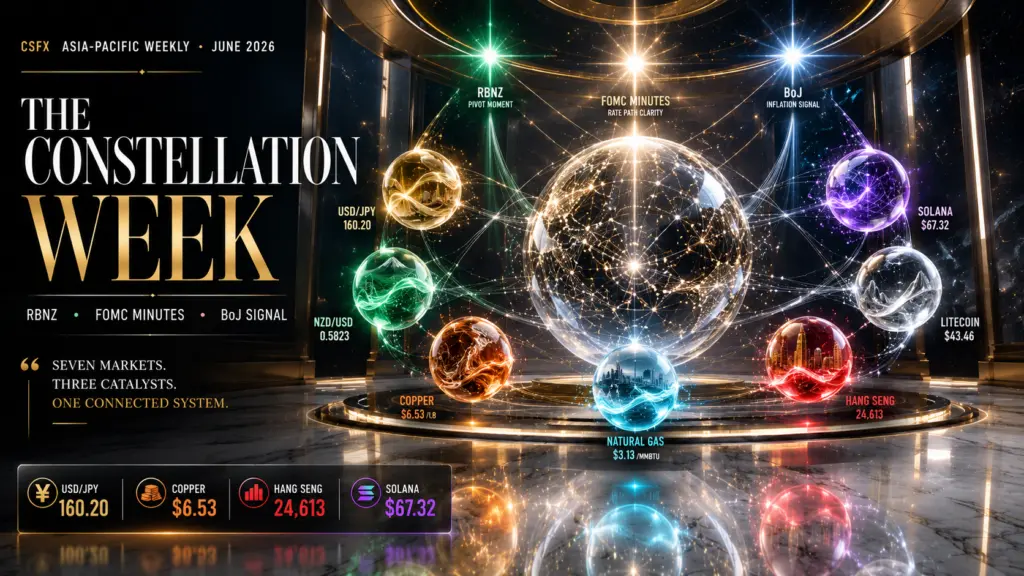
USD/JPY Returns to 160.20, Copper Surges to $6.53 & Hang Seng Retraces to 24,613

USD/JPY Returns to 160.20, Copper Surges to $6.53 & Hang Seng Retraces to 24,613

Saturday, 13 June 2026  ·  Capital Street FX Research Desk

USD/JPY 160.20  ·  NZD/USD 0.5823  ·  Copper $6.53  ·  Nat Gas $3.13  ·  Hang Seng 24,613.3  ·  SOL $67.32  ·  LTC $43.46

Past Week in Review — 9–13 June 2026

The week of 9–13 June 2026 pivoted dramatically on geopolitics. President Trump's remarks on Thursday that a US-Iran peace deal could be signed as soon as this weekend in Europe triggered an aggressive risk-on move across all Asia-Pacific assets. The Hang Seng's 1,946-point weekly surge — from a four-session losing streak low to a 26,626 high — was the most decisive single-week move since March 2025, led by SMIC up 8.4% and Tencent up 4.2%. USD/JPY touched a fresh multi-year high of 160.57 on Thursday — its weakest level since July 2024 — before retreating to 160.20 as the yen climbed 0.6% on the ceasefire remarks. Natural gas shed its Middle East supply risk premium, falling 4.35% on the week as LNG cargo competition eased. Copper recovered sharply to $6.53, well above the $6.20 support, as Jefferies' structural upgrade — forecasting an average 491,000-ton annual supply deficit through 2030 — attracted dip-buying. Solana recovered 11.73% from the $58 structural support zone driven by the Alpenglow consensus protocol upgrade and $15.6 million in spot ETF inflows. Litecoin stabilised within the $40 to $44 demand zone with initial bottom-building capital inflows.


This Week at a Glance — 16–20 June 2026

The week of 16–20 June 2026 is defined by a sequential central bank event structure with direct implications for every instrument in CSFX's Asia coverage. The RBNZ's hawkish pivot last week — signalling rates could rise earlier and by a larger-than-expected margin — has created a structural NZD floor at 0.5800. Wednesday's FOMC minutes are the primary USD direction setter: hawkish...

Continue reading...
0
0

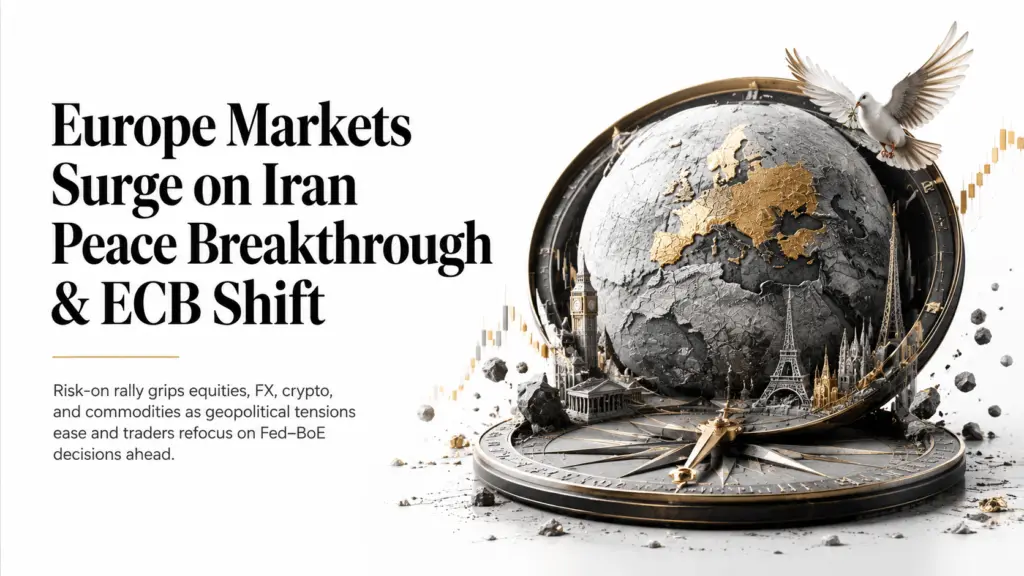
Iran Peace Breakthrough Sparks a Risk-On Rally as ECB & CPI Clear

Iran Peace Breakthrough Sparks a Risk-On Rally as ECB & CPI Clear

Friday, 12 June 2026  ·  Capital Street FX Research Desk

EUR/USD 1.1579  ·  GBP/USD 1.3415  ·  DAX 24,668  ·  Silver $67.02  ·  Nat Gas $3.05  ·  BP 545p  ·  Bund 20Y 3.42%  ·  ETH $1,674  ·  LINK $7.89  ·  BTC $63,577

Session Overview

Europe opens Friday in full relief mode. Overnight President Trump called off fresh strikes on Iran and pointed to a breakthrough in talks to end the war — the firmest de-escalation signal in months — and with this week's two macro hurdles now cleared (the hot-but-soft-core US May CPI and the ECB's 25 basis-point hike to 2.25%), the continent is trading a clean risk-on rotation rather than a war-and-policy binary.

The pivot is sharp and broad. The Stoxx 600 is up about 1.7%, led by the most war-sensitive corners of the market: travel and leisure surged more than 4.9% — TUI +8.5%, Ryanair +7.5%, Lufthansa +6.9% — while European banks added 3.7% as the curve and the rate outlook firmed. The mirror image is energy: with crude sliding on the peace signal, oil majors and the wider energy complex are the session's clear laggards, dragging on the FTSE 100 and on names like BP even as the broad tape rips higher.

The ECB hiked to 2.25% on Thursday — its first move since 2023 — and turned hawkish, lifting 2026 headline inflation forecasts to 3.0% and pricing roughly a 50% chance of a follow-up in September, even as it trimmed growth to 0.8%. The euro sold the fact, with EUR/USD slipping toward 1.1579 near its lowest since early April, as a firm dollar and a draining haven bid outweighed the rate-gap story. Attention now jumps to next week's back-to-back central-bank events: the Fed on June 17 — Kevin Warsh's debut meeting as Chair, expected to hold at...

Continue reading...
0
0

Iran Peace Deal ‘Largely Negotiated’ Sends Oil Crashing & Risk Soaring as BoJ Hike Week Begins

Iran Peace Deal ‘Largely Negotiated’ Sends Oil Crashing & Risk Soaring as BoJ Hike Week Begins

Friday, 12 June 2026  ·  Capital Street FX Research Desk

USD/JPY 160.29  ·  AUD/USD 0.7031  ·  Hang Seng 24,702.6  ·  Copper $6.40  ·  WTI $86.30  ·  BTC $63,427.90  ·  DOGE $0.0860  ·  LTC $42.00  ·  Gold $4,205

Session Overview

Asia wakes up to the sharpest sentiment reversal of the month. Late Thursday, President Trump posted that a peace agreement with Iran — one that would reopen the Strait of Hormuz and end the three-month conflict — is largely negotiated and will be announced shortly, with a memorandum of understanding awaiting final sign-off from Washington and Tehran. The market reaction was immediate and violent: crude oil cratered roughly 4% to its lowest level since mid-May near $86.30, ripping the geopolitical war premium out of the energy complex overnight and triggering a broad risk-on rotation into equities, industrial metals, and crypto just as the region heads into the year's most consequential central-bank week.

The reaction across the region is a clean, one-directional risk rally — almost the mirror image of the past month's war-driven defensiveness. Hong Kong's Hang Seng is firmer near 24,702.6 as oil-import-sensitive Asian equities cheer the prospect of a durable de-escalation, while Japan's Nikkei extends its advance with exporters tracking a still-weak yen. USD/JPY is pinned at 160.29, effectively glued to the intervention line even as the broader risk tape turns constructive — the Iran de-escalation removes one inflationary leg (energy) just days before a Bank of Japan that was already leaning hawkish on a separate leg (wholesale prices at 6.3%). Copper has rebounded sharply off three-week lows toward $6.40 per pound as the growth-friendly headline outweighs the loss of its modest oil-linked cost-push support, while gold holds a haven bid near $4,205 — a sign the de-escalation is being read as real but not yet done.

The crypto...

Continue reading...
0
0
Navigation menu
instaforex banner